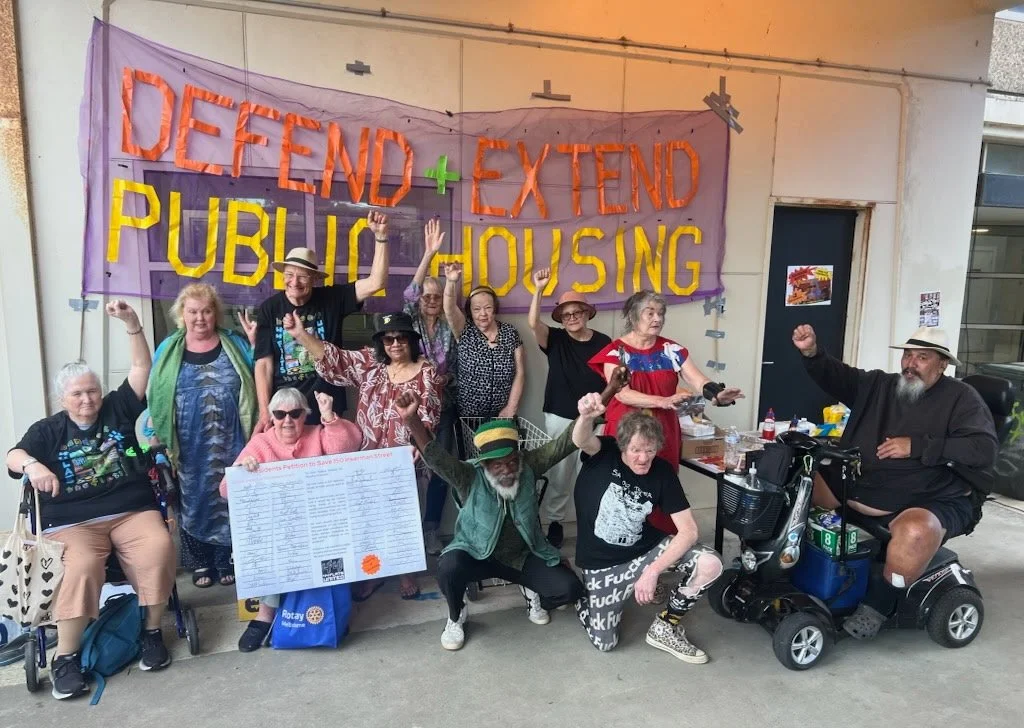
We need PHIMBYs* not envoys
The Save Public Housing Collective congratulates Josh Burns, the Member for Macnamara, on his role as Federal social housing envoy. It seems to be going brilliantly so far, especially in his own electorate which has seen the loss of both public and community housing estates over the past few years.
Already this year two announcements sent shockwaves through the affected communities: in January Homes Victoria declared that both the Inkerman St, St Kilda and Victoria Avenue, Albert Park, public housing towers dedicated to older people will be demolished in the third tranche of tower demolitions. This has left frail, vulnerable residents feeling bewildered as they face an uncertain future – where will they go and will their health sustain the upheaval? Many people in these towers are in their nineties and most believed they were settled in their ‘forever homes’. No compelling reason has been provided to justify bulldozing either of these towers.
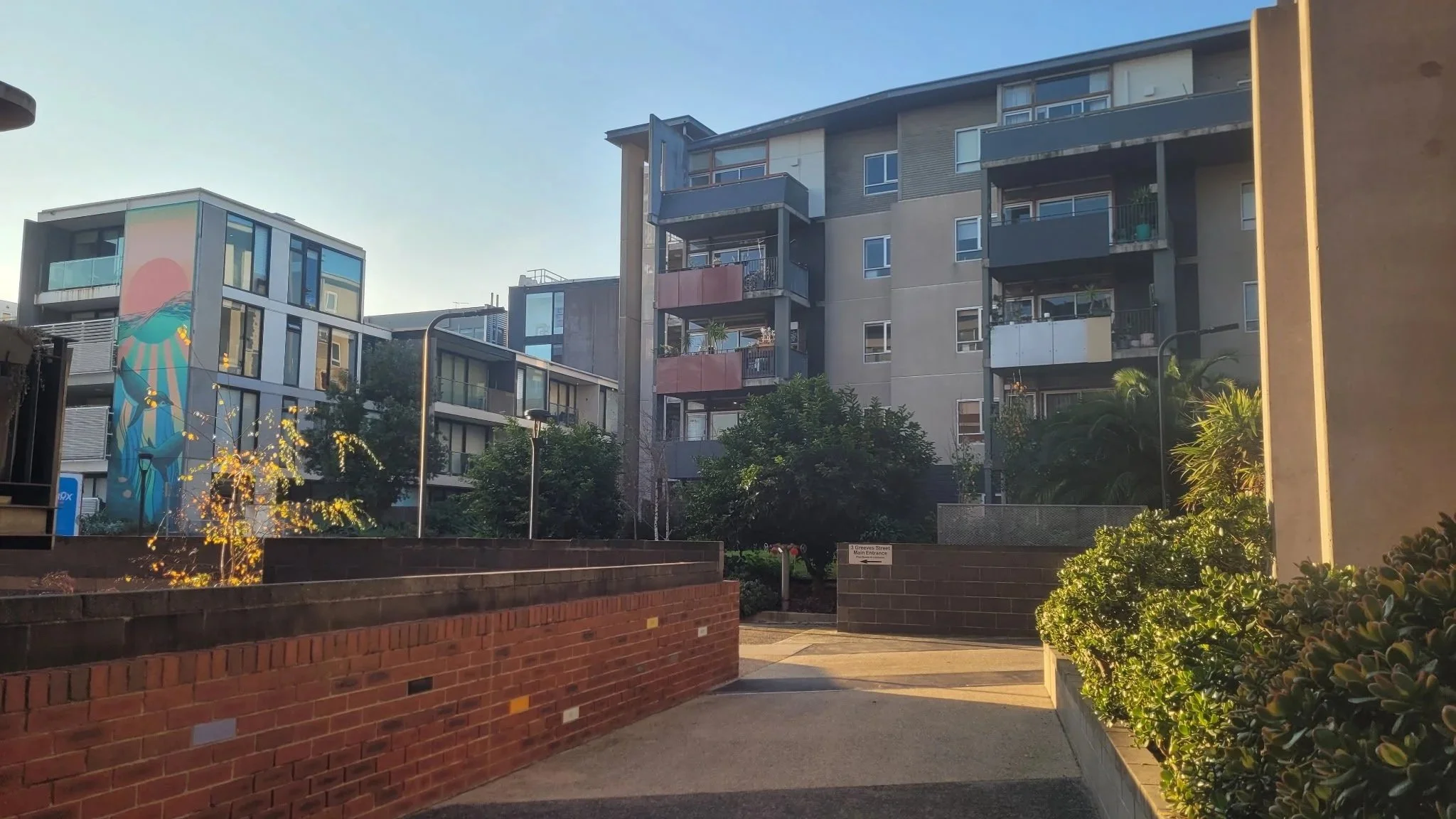
The Oasis estate, St. Kilda.
Most recently, as first reported by TWISK 22/03/26, and followed up in subsequent weeks, Housing First will offload the community housing at the Oasis estate in Greeves St, St Kilda due to ongoing cost concerns. Yet, Housing Associations enjoy tax-free status and 100% of each renter’s Commonwealth Rental Allowance (CRA). While CRA was originally designed to help low-income renters meet housing costs, it is now the linchpin of this model’s revenue stream, along with rent set at 30% of income. It’s hard to fathom how Housing First couldn’t balance the books but perhaps it’s due to the Housing Associations’ neo-liberal, growth-oriented model which is grounded in perpetually boosting the financial bottom line. It’s not enough to tread water, they always need to be seeking new opportunities to expand their asset portfolios.
This mass sell-off comes on top of the forced relocation of Housing First residents at the Grosvenor St, Balaclava estate. They were moved on in 2023-24, sadly with very little public acknowledgment of their plight. Originally a disused Telecom site, the estate was constructed in the nineties and appeared to be a charming enclave of townhouses, the same design and vintage as my Port Melbourne public housing estate. Any claims the buildings were ‘past their use by date’ would be risible.
Writing on his Art Blat online archive , Dr Marcus Bunyan describes how residents were displaced from a tranquil, crime-free setting into more congested buildings rife with anti-social problems, resulting in diminished well-being.
According to the Officer’s Assessment Report, the replacement will comprise 68 units in two blocks, funded through Victoria’s Big Housing Build at a cost of $36.5 million – it’s unclear what Housing First’s contribution will be.
Rewind to Christmas 2021: Barak Beacon, Port Melbourne public housing residents were distraught to learn that their much-loved homes would be bulldozed. With generous slabs of open space and a beachside locale, the drawcard for developers and community housing entrepreneurs alike was obvious. Five years on, the former park-like estate has metamorphized into a high-density, multi-storey concrete jungle – from a swan to an ugly duckling.
We note the concern voiced by Josh Burns to ensure Oasis residents are suitably relocated but where was the support for Barak Beacon residents? Their trauma and ensuing ill health went largely unnoticed by local politicians and Homes Victoria.
To paraphrase Oscar Wilde, “to lose one estate may be regarded as a misfortune, to lose two or more looks like carelessness.” And that’s the issue - the authorities care little. Neither resident welfare nor the housing insecurity and homelessness faced by the near-60 thousand applicants languishing on the Victorian Housing Register waiting list - corresponding to about 100,000 people - are a priority for the Allan Labor government. Public housing staff lament the near-insurmountable task of securing properties for those on the waiting list as most of the vacant stock is required for residents forced to relocate from the towers slated for impending demolition.
OFFICE, an architectural non-profit firm, created an alternative design for Barak Beacon which would have enabled residents to remain on site while existing units were renovated. Combined with infill construction on the unused green space, the government’s desired new build total of 350 units could be achieved, at a saving of about $88 million in comparison to the government’s ‘slash and burn’ project. But instead of dialoguing with OFFICE, Homes Victoria snubbed them. Three design teams have now created retrofitting plans across five different estates but the government persists in ostrich-like obstinacy.
Writing in The Conversation, a member of one of these design teams, architect Nigel Bertram, describes how three different scenarios were modelled at the Fitzroy towers (Atherton Gardens). It found that retrofitting produced substantial savings in costs, embodied carbon and construction time compared to erecting a new building.
As all 44 public housing towers face demolition, Bertram estimates that renovating them instead “could save around A$1.5 billion in construction costs” as well as reducing greenhouse gas emissions.
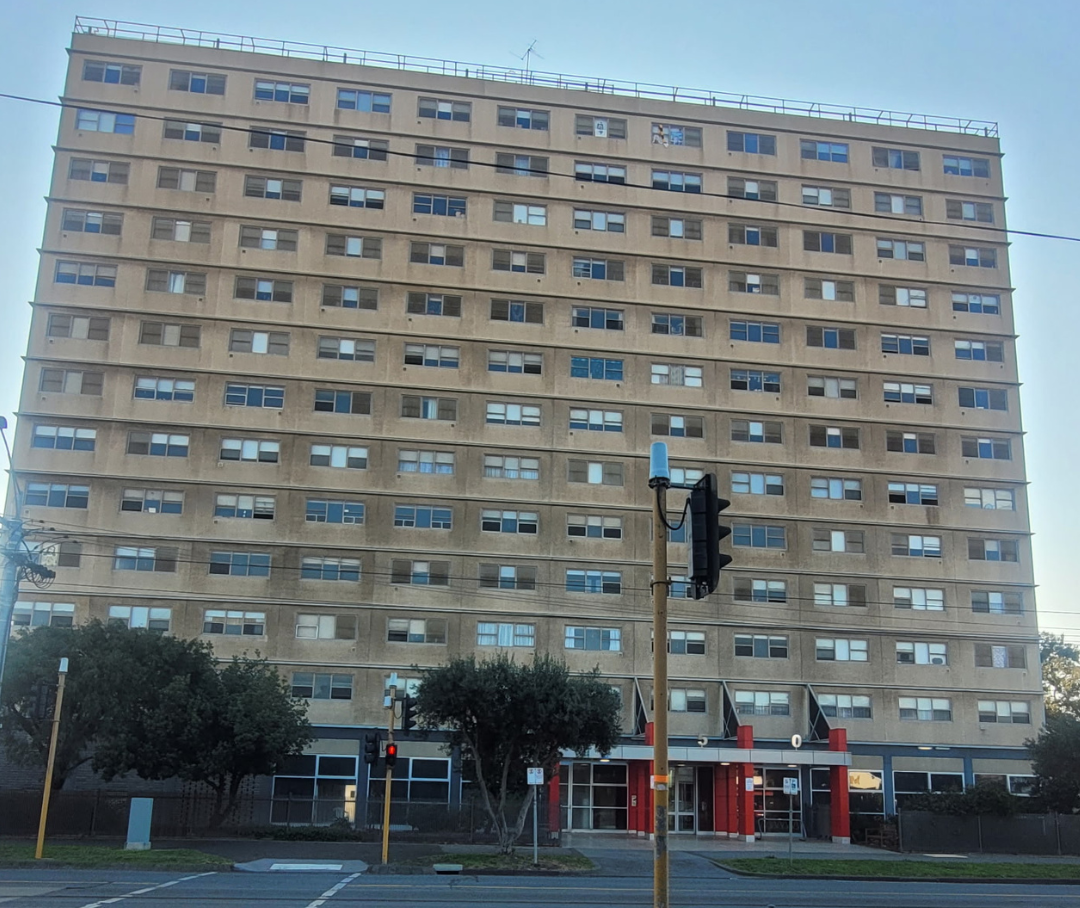
Albert Park Older Persons block.
It’s unlikely any of these Homes Victoria projects will leave a sizeable dint in the waiting list, as the requirement for the former public housing sites is a mere 10% increase in stock, to be delivered as community housing. The rest of the former estates will comprise so-called affordable housing and market rentals or sales which offer higher yields - a core driver of the demolition program is to generate investment opportunities for the Super funds and other institutional players.
For example, at Barak Beacon the previous 89 homes will be replaced by 130 community housing units, and the remaining 278 will be a mix of affordable and market rentals.
Through Homes Victoria, the body with an external Advisory Board superimposed on the public housing system, the Labor Government continues to cannibalise public housing estates. Instead, surplus State and Commonwealth land parcels could be utilised for public housing construction, rather than sold, to help clear the backlog of waiting list applicants.
If the State Government can afford to throw $100m at the Grand Prix annually, it can afford to buy up the Oasis units and run them efficiently as ‘spot purchase’ public housing within the private Oasis complex.
It’s always been a hard ask to get support locally in Port Phillip for public housing: both Council & community groups seem to be steeped in a sniffy middle-class aversion to public housing. While support for Housing First across its various historical iterations has been strong, particularly as it was originally propped up by St Kilda Council as an alternative to rising private rents – ratepayer contributions were a key component of the financial structure until about 10 years ago.
It’s nearly 25 years since the Bracks Labor Government opted to jettison public housing in favour of the Housing Association model. We were told it would be more economical, with improved management; “the private sector can do it better” and so on. Yet we have rising homelessness and a decade-long waiting list that is shameful for a first world country. Until they became beneficiaries of the public housing redevelopment programs, Housing Associations weren’t obliged to house many applicants, if any, from the Priority segment of the waiting list. Their preference is for higher-earning renters. Hence the backlog and the despair of Victorians who can’t afford private rentals. Crisis housing workers often burnout after a couple of years as the stress of having to constantly turn away desperate people eats into their souls. Can we just call it out? The model isn’t working.
In comparison, to quote from the RMIT report analysing Barak Beacon and related projects, “Aside from the construction cost of establishing new estates, public housing communities are cost neutral” as rents generally pay for tenancy and stock management.
Yet, the Allan Government, backed by their Federal colleagues, is determined to shed public housing assets simply because they no longer believe that governments should provide cheap, reliable services for low income citizens. They’ve swallowed the kool-aid that the private sector are more efficient operators. At a recent homelessness forum, then Housing Minister Harriet Shing declared “I'd like to do myself out of a portfolio” by resourcing community providers instead.
We have every right to question the ethics and motivations of the public and community housing decision-makers responsible for causing massive displacements and ensuing trauma.
If Josh Burns wants his envoy role to be taken seriously, he needs to start listening to the affected residents and the groups advocating for public housing – a skilful envoy works both sides of the fence. Otherwise, his role amounts to sugar-coating this unpalatable privatisation of public assets. While he’s spruiking the benefits of estate demolitions, it will be dawning on people that what’s happened at Oasis and Grosvenor St could be the trajectory for other, former public housing estates given over to the community housing corporations. Sadly, happy endings and forever homes remain elusive for those in housing precarity.
The Save Public Housing Collective cordially invites Josh Burns to one of our monthly meetings – there’ll be tea and cake, and some tough questions. Are you up for it, Josh?
Definition
*PHIMBY: Public Housing In My Backyard
Postscript
Thanks to the intrepid outreach of the 44 Flats United group, nearly 100% of residents at the Inkerman Street block have now pledged to remain there. To celebrate, 44FU hosted a fantastic afternoon of performances by local musos, all keen to support the residents, and with some musos living in the targeted building. The Victoria Avenue block is well on the way to achieving a similar target.
In her final public event as Housing Minister, on April 13 2026 Harriet Shing turned the first sod at Grosvenor street. For reasons we’re not clear on, they’ve actually been excavating the site for the past six months but it’s now all filled in again, in time for her appearance. Couldn’t they have found another site for these proposed 68 units instead of obliterating a trouble-free estate?